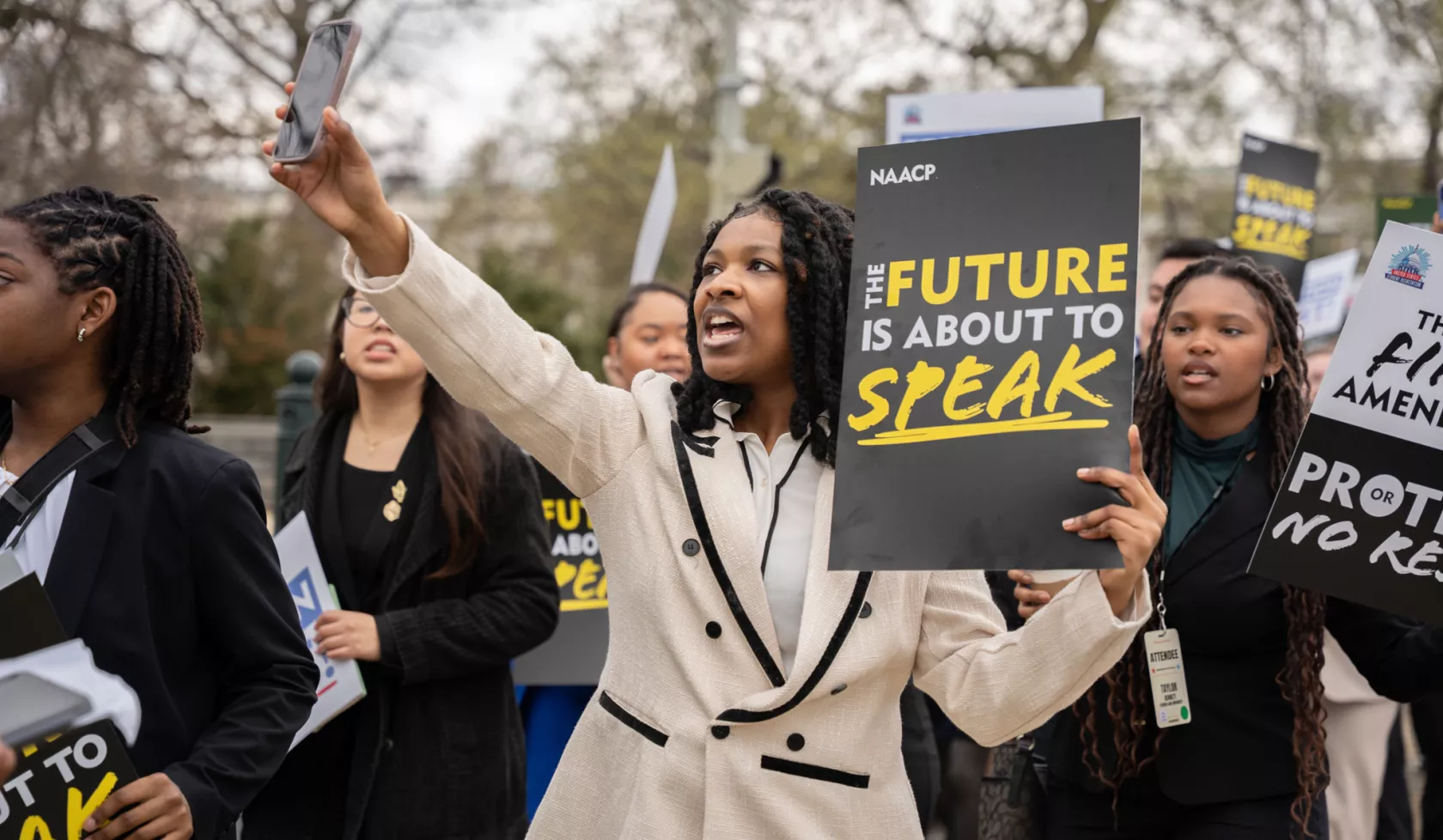

The NAACP has launched a national campaign urging Black student-athletes to reconsider committing to colleges in several Southern states following a recent U.S. Supreme Court ruling that weakened protections under the Voting Rights Act of 1965.
The organization says the decision has accelerated efforts to dismantle majority-Black voting districts across the South, threatening Black political representation while universities in those same states continue to benefit heavily from the athletic talent and economic influence of Black athletes.
“The NAACP will not watch the same institutions that depend on Black athletic prowess to fill their stadiums and their bank accounts remain silent while their states strip Black communities of their voice,” said Derrick Johnson.
The campaign specifically targets universities located in Tennessee, Louisiana, Alabama, Florida, Mississippi, South Carolina, Texas, and Georgia — many of which compete in the powerful Southeastern Conference, commonly known as the SEC. Several of the schools mentioned are home to nationally recognized football programs that generate hundreds of millions of dollars annually through television contracts, ticket sales, sponsorships, and merchandise.
The NAACP’s position reflects a growing intersection between sports, civil rights, and political activism. Historically Black athletes have often stood at the forefront of social justice movements, from the protests of Muhammad Ali and Tommie Smith to more recent activism led by Colin Kaepernick and college athletes advocating for racial equity and voting access.
Civil rights advocates argue that the Supreme Court decision opened the door for Republican-led legislatures in several Southern states to redraw congressional maps in ways that dilute Black voting power. The controversy intensified after efforts emerged to eliminate or weaken majority-Black congressional districts in states including Alabama and Louisiana, both of which have faced ongoing legal battles over redistricting.
The NAACP’s call is not an official NCAA action and does not mandate athlete participation. Instead, it is designed as an economic and moral pressure campaign aimed at forcing universities and state leaders to publicly address voting rights concerns.
Supporters of the boycott effort argue that Black athletes wield enormous influence within college athletics and should use that leverage to challenge policies they view as harmful to Black communities. Critics, however, contend that boycotts could unintentionally affect athletes’ educational and professional opportunities while placing universities in the middle of broader political disputes.
The campaign also raises broader questions about the relationship between higher education institutions and the political environments in which they operate. Universities in the targeted states recruit heavily from predominantly Black communities nationwide while many of those same states face criticism over voting access, diversity initiatives, and racial equity policies.
The debate arrives during a period of significant change in college athletics, with athletes increasingly empowered through NIL (Name, Image, and Likeness) deals, transfer portal mobility, and expanding public platforms. Analysts say that empowerment could make political activism among recruits and players more influential than at any point in NCAA history.
Whether the boycott gains widespread traction among top recruits remains uncertain. But the NAACP’s announcement signals a new phase in the ongoing national battle over voting rights, race, and political representation — one in which college sports may become an increasingly visible arena for civil rights activism.