

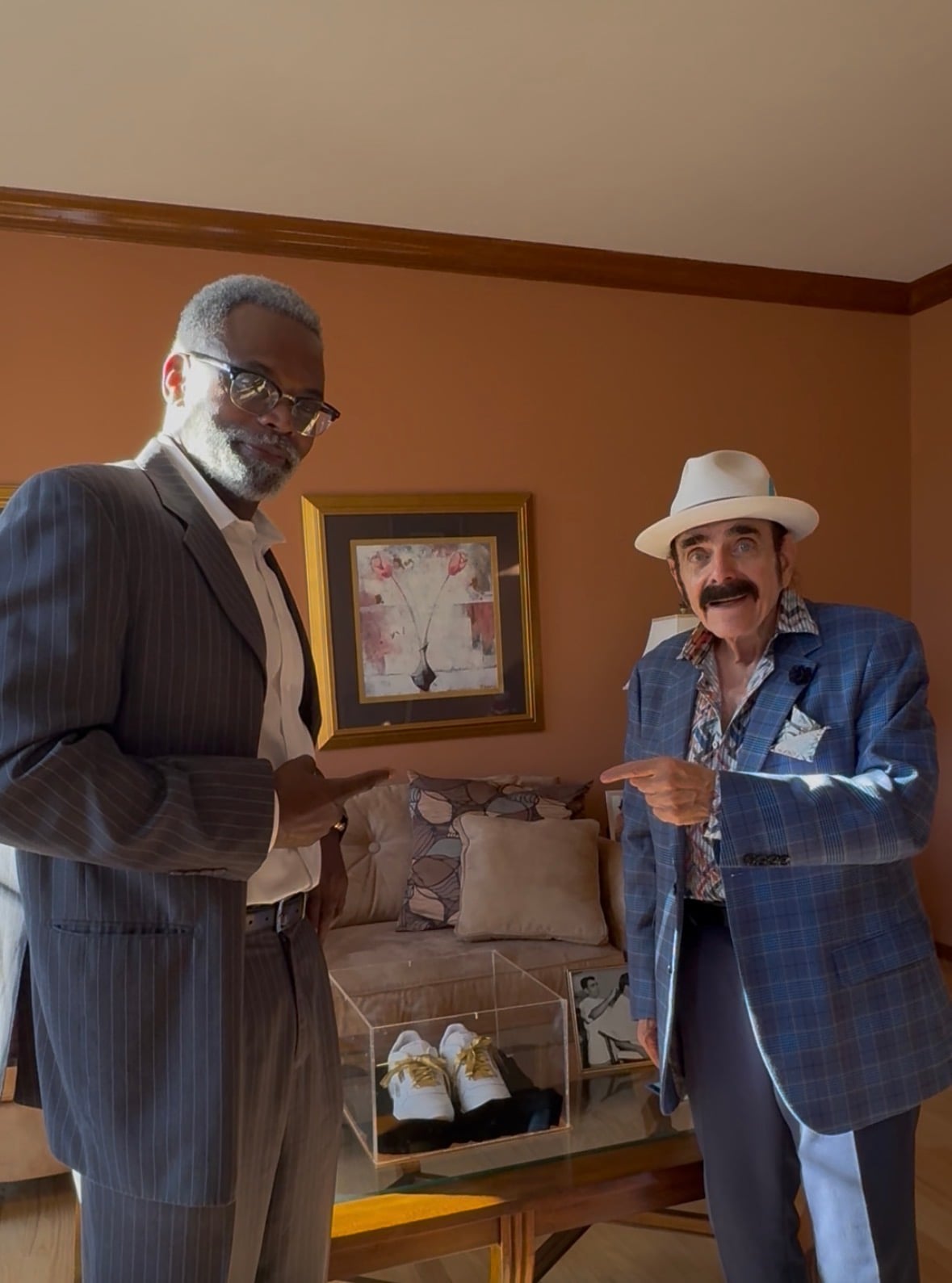
For a brief and uncomfortable moment, St. Louis believed it had lost one of its cultural pillars.
Like many, the Argus ran an in memoriam piece marking the reported passing of Gus Torregrossa, the legendary proprietor of Gus Fashions and Shoes—a man whose name is stitched into the fabric of Washington Avenue, hip-hop history, and Black–Italian community bonds that predate hashtags and hype.
The next morning, the phone rang.
On the other end was Vinny, Gus’s son. He thanked us—genuinely—for the article, for the respect, for the kind words Then, almost casually, he said, “Hold on. I want you to talk to someone.” And suddenly, the dead man was on the phone.
“I ain’t dead yet!” Gus laughed, sharp and unmistakably alive.
What began as a social-media-fueled media faux pas turned into something rare in modern journalism: a correction that opened the door to an unscripted, intimate interview in the living room of a living legend. The erroneous reports had spread quickly across Facebook posts, reposts, and digital whispers. No malice—just the familiar danger of speed without verification. But what followed was unexpected grace. Gus didn’t bristle. He joked. He welcomed us in. And he talked.
What unfolded was less an interview than a masterclass in St. Louis history.
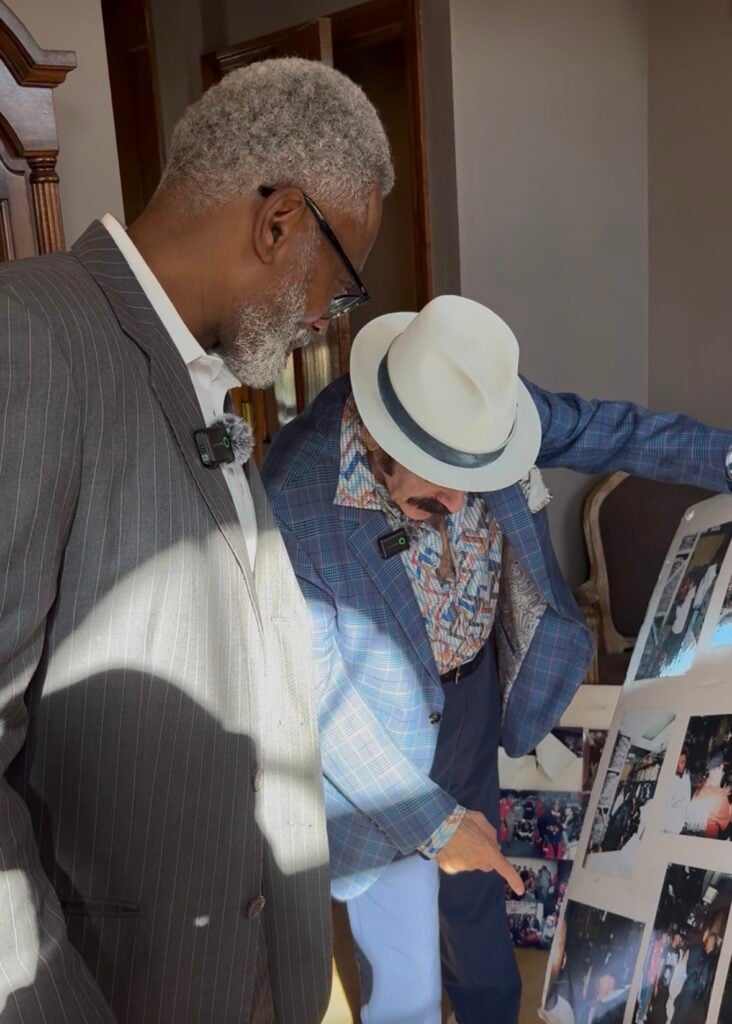
Gus reflected on his upbringing, his humble beginnings, and the poverty that shaped him—conditions that mirrored those of many Black families in the neighborhoods that would later embrace him. Those shared struggles forged real friendships, not performative alliances. He spoke plainly about proximity, survival, and mutual respect—long before diversity became a corporate slogan.
To many outside the city, Gus is known as the fashion kingpin: the man behind the glass cases and bold racks at 1201 Washington Avenue, a Midwest mecca of merchandise. Rappers, entertainers, athletes—if they came through St. Louis in the ’80s, ’90s, or early 2000s, they came through Gus’s.
But what often gets missed is the philanthropy. The quiet generosity. The way Gus showed up for community causes, families in need, and individuals down on their luck—no cameras, no press releases. Giving, for him, was relational, not transactional.
During the conversation, Gus casually referenced relationships that, to historians and longtime St. Louisans, carry real weight. He spoke matter-of-factly about encounters and conversations with figures whose names once echoed through the city’s political and underworld corridors—men like Frank “Buster” Wortman, Jimmy Hoffa, Mike Trupiano, and Anthony Giordano. There was no bravado in the telling, no embellishment—just the reality of a man who
operated in spaces where business, politics, labor, and street power often overlapped. Gus understood those worlds, navigated them, and, importantly, survived them with his integrity intact.
His civic footprint extended beyond commerce. Gus spoke with particular pride about his support for the establishment of the Dismas House of St. Louis, a halfway house rooted in the belief that redemption, second chances, and human dignity must be lived values, not abstract ideals. That commitment aligned naturally with his long-standing relationship with Father Charles Dismas Clark, whose work bridged faith, justice, and compassion for society’s forgotten.
Adding texture to the moment was the presence of Lil Jimmy, a familiar face to anyone who spent time in the shop. His reflections added another layer—stories of loyalty, humor, and the rhythm of daily life inside a store that was never just a store.
Then came the interruption.
A phone rang. Not just any ringtone, but the unmistakable theme from The Godfather. On the line was Gus’s cousin, Mark Cusumano of Kemoll’s fame, calling to confirm—half-joking, half- relieved—whether Gus was truly alive after hearing the same reports.
The room erupted in laughter.
The walls themselves told stories. Photographs resurrected the golden eras of rap and hip-hop in the early, mid, and late ’80s and ’90s. There were also images from an earlier chapter: a young Gus, his family, and a striking photo of Gus as the “Hoodlum Barber,” cutting the hair of actor Don Murray, who portrayed Father Clark in the 1961 film Hoodlum Priest—with Father Clark himself nearby.
What emerged was a deeper respect for the life and contributions of Gus Torregrossa—beyond fashion, beyond fame, into the realm of community memory and living history. Nearly nine decades into life, Gus remains sharp in mind, strong in spirit, and—unsurprisingly—impeccable in dress.
The media may have written his ending too soon. But Gus Torregrossa, very much alive, still had a chapter to give—and St. Louis was better for
hearing it.


Wow! I use to buy his clothes when I went to school in KC, and took trips to STL.
(Do you all have a subscription link?)
I got to see him last year at Home Depot in South County. He was still Gus. He and his wife were together. Beautiful couple
I loved Gus, he loved people every time he attended an event at Royale Orleans he always drew a crowd.
I loved his personality and he seemed know all the gossip in town.. I will miss him truly one of a kind.