


In the wake of disaster, St. Louis residents call for decisive leadership and a clear recovery plan.
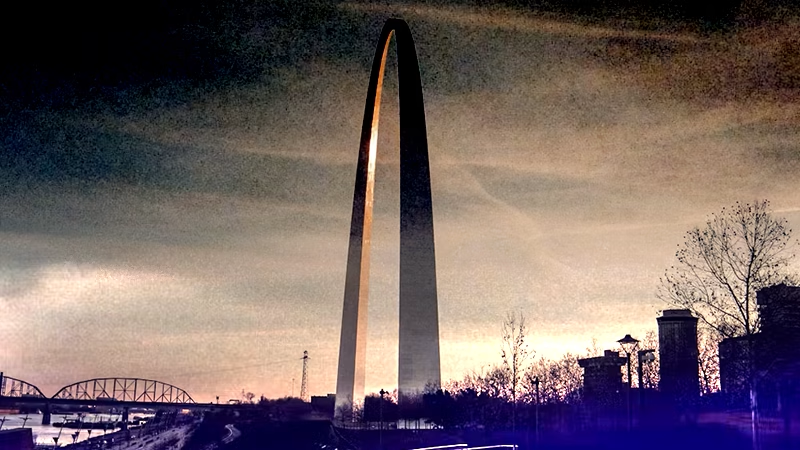
On May 16, 2025, a tornado cut through the heart of St. Louis, leaving homes shattered, businesses damaged, and lives uprooted. In the aftermath of such devastation, residents expected swift, transparent leadership from City Hall. Instead, we have been met with silence, excuses, and misplaced blame aimed at the federal government.
It is important for residents to understand: this is not a federal failure. It is a failure of local leadership.
The tornado struck a city already weakened by decades of disinvestment. For years, St. Louis has experienced population decline, crumbling infrastructure, and underfunded schools—leaving many neighborhoods fragile before the storm even arrived. Disinvestment eroded resilience, leaving the city less able to withstand disaster and less prepared to recover quickly (Pastor et al., 2006).
When leaders fail to act decisively in this context, the impact is compounded. Families already living on the edge are pushed into deeper crisis, and neighborhoods that were vulnerable before the storm now face long-term destabilization.
The National Response Framework (NRF) is explicit: disasters are to be managed at the “lowest jurisdictional level possible” (Department of Homeland Security [DHS], 2019). Local leaders are responsible for implementing the Incident Command System (ICS), which provides structure, accountability, and coordination during crises (National Incident Management System [NIMS], 2017).
Federal agencies such as FEMA cannot “take over” recovery. Their role is to support local governments once requests and documentation are properly submitted (FEMA, 2023). When city officials delay action, fail to implement ICS, or neglect to communicate clearly, they prevent residents from accessing the full range of resources available.
The absence of a recovery plan is not just an oversight—it is a choice that will have lasting effects:
Population Decline: Without recovery, more families will leave St. Louis, further shrinking the tax base and reducing the city’s ability to provide essential services (Frey, 2018).
Struggling Schools: As families depart, schools lose students and funding, weakening educational opportunities and limiting the future prospects of young people (Peek, 2008).
Economic Instability: Businesses require stability to thrive. Leadership failure undermines investor confidence, discourages new development, and accelerates job loss (Smith & Wenger, 2006).
Regional Impact: St. Louis is a hub for the entire metropolitan area. When the city falters, it drags down regional commerce, competitiveness, and growth.
These outcomes are not theoretical—they are patterns observed repeatedly in communities where disaster response has been slow, fragmented, or absent.
Residents of St. Louis deserve leaders who acknowledge the city’s history of disinvestment and rise to the challenge of building resilience. Instead, we have leaders who deflect responsibility and leave families to navigate disaster alone.
Recovery is not just about clearing debris or repairing buildings. It is about restoring trust, stabilizing communities, and ensuring that residents, especially those already marginalized, have the support they need to rebuild their lives. Without immediate and decisive action and a plan, the legacy of this tornado will not be measured only in destroyed homes, but in years of lost opportunity and deepening inequity.
The people of St. Louis are resilient and always have been. But resilience without leadership is unsustainable. If City Hall does not act with urgency, more residents will leave, schools will continue to weaken, businesses will close, and the city will continue to decline.
It is time to demand more. Ask for the plan. Insist on accountability. Hold leaders to the standards that every jurisdiction in this country is required to meet. St. Louis deserves leadership equal to the strength of its people.
References
Department of Homeland Security. (2019). National Response Framework (4th ed.). U.S. Department of Homeland Security. https://www.fema.gov/emergency-managers/nrf
Federal Emergency Management Agency. (2023). Disaster Recovery: A Guide for Local Governments. FEMA. https://www.fema.gov
National Incident Management System. (2017). Third Edition. U.S. Department of Homeland Security. https://www.fema.gov/emergency-managers/nims
Frey, W. H. (2018). The US population is moving to the South, but St. Louis continues to shrink. Brookings Institution. https://www.brookings.edu
Pastor, M., Bullard, R. D., Boyce, J. K., Fothergill, A., Morello-Frosch, R., & Wright, B. (2006). In the Wake of the Storm: Environment, Disaster, and Race After Katrina. Russell Sage Foundation.
Peek, L. (2008). Children and disasters: Understanding vulnerability, developing capacities, and promoting resilience—An introduction. Children, Youth and Environments, 18(1), 1–29.
Smith, G., & Wenger, D. (2006). Sustainable disaster recovery: Operationalizing an existing agenda. In H. Rodríguez, E. L. Quarantelli, & R. R. Dynes (Eds.), Handbook of Disaster Research (pp. 234–257). Springer.
#StLouisStrong #LeadershipMatters #TornadoRecovery

