

Exodus, Family, and Domination
What is often dismissed as “Black violence” or “Negro aggression” has long functioned as a political label rather than an honest description of social reality. Framed in this way, Black suffering is moralized, resistance is criminalized, and the systems that produce both are rendered invisible.
It was within this context that I attended a lecture by Dr. Wesley Muhammad, whose argument powerfully names what has too often been obscured. Grounded in Exodus 1:19, Dr. Muhammad draws attention to Pharaoh’s command to kill the sons while sparing the daughters, exposing it as a
deliberate strategy of domination—one aimed at dismantling a people by severing Black masculinity from continuity, protection, and inheritance. His work insists that the targeting of Black men and boys has never been incidental or cultural, but systemic and calculated.
That clarity matters. It resists narratives that blame Black men for their own dispossession or explain their suffering as moral failure. By tying modern policing, surveillance, and biochemical warfare back to biblical logic, Muhammad restores historical truth: Black men were targeted because of what they
represented—future, authority, covenant, and continuity. Any honest conversation about family, community, or survival must begin there.
From that truth—not in opposition to it—the conversation widened. As the lecture moved into dialogue, women—me included—began reflecting on the implications of sparing the daughters and what this same logic of domination has produced within Black family life over time. This was not an
attempt to redirect Dr. Muhammad’s argument or displace its focus on Black men. It was an effort to remain aligned with it by asking what such a strategy yields across generations.
Killing the sons and sparing the daughters functioned together as a form of domination. Sparing the daughters did not signal divine mercy. It shifted the burden of survival onto women—fracturing masculinity while overloading femininity—leaving the family intact in form but hollowed in power.
Women were praised as strong while denied protection, expected to carry households without authority, to absorb absence without complaint, and to endure instability without recognition.
Over time, survival itself became reframed from virtue. Modesty was cast backward. Faith became disposable. Material endurance was elevated as empowerment, even when it masked exhaustion and loss. Women were not liberated; they were rendered indispensable and invisible at the same time.
Scripture does not leave this moral terrain unnamed. The midwives of Exodus stand at the center of the story—not Pharaoh. Commanded to kill the sons and spare the daughters, they refuse. Their resistance is quiet and faithful. They preserve life while rejecting a system that seeks to redefine evil
as a necessity.
Womanist theologian Emily Townes names this distortion in the cultural production of evil—the normalization of harm through policy, narrative, and repetition, until domination is mistaken for order. Under Pharaoh, control of family structure was framed as governance. Today it is often framed
as public safety, social stability, or individual choice. The midwives refuse the script and preserve moral clarity against manufactured ethics.
The Qur’an names this truth with unflinching clarity. In Surah 7:127, Pharaoh’s strategy is revealed without euphemism: killing the sons and sparing the women was never the end— “surely, we will dominate over them.” Survival alone is not liberation when domination remains intact. Control of
family structure is named as moral failure.
Black families have always practiced resistance through care, courage, and community. But Scripture warns us not to confuse endurance with justice. When survival is demanded on oppressive terms, it hollows power and distorts love. The task before us now is not only to survive, but to discern—to
refuse moral narratives that excuse domination and to reclaim ethical frameworks where Black families can flourish whole.
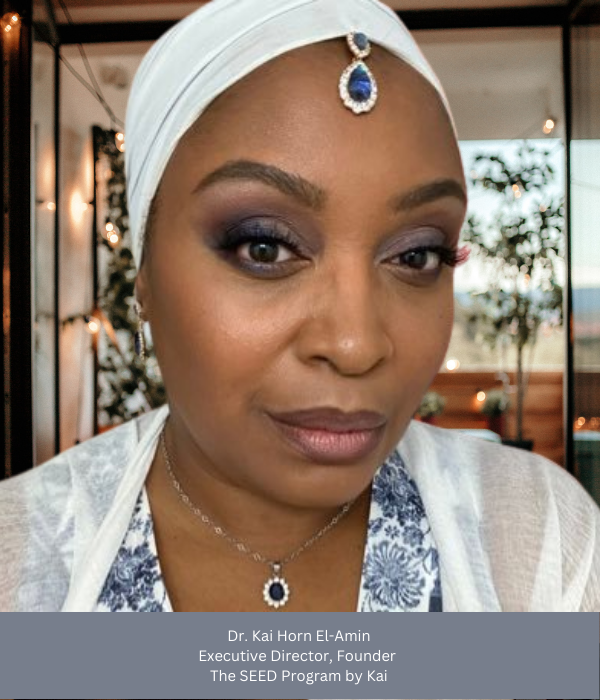
Dr. Safiyyah Kai El-Amin is a chaplain and writer focusing on Islamic theology, ecology, anthropology, and Niswiyya (womanist) perspectives on faith and family.

