

Argus Staff Report
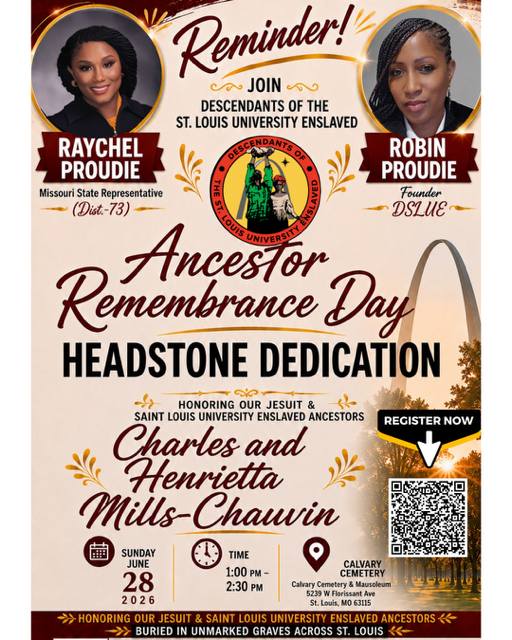
As the nation begins commemorating America’s 250th anniversary, a local organization is inviting the community to reflect on a chapter of history that has too often remained overlooked. The Descendants of the St. Louis University Enslaved (DSLUE) will host an Ancestor Remembrance Day Headstone Dedication Ceremony on Sunday, June 28, recognizing two formerly enslaved individuals whose lives were intertwined with the early history of St. Louis and one of its most prominent institutions.
The ceremony, scheduled from 1 to 2:30 p.m. at Calvary Cemetery, will honor Charles and Henrietta Mills-Chauvin, direct ancestors of present-day DSLUE members who were among the African Americans enslaved by the Jesuits during the nineteenth century. After generations in unmarked graves, the couple will finally receive a permanent headstone provided by Saint Louis University, offering long-awaited recognition of their lives and contributions.
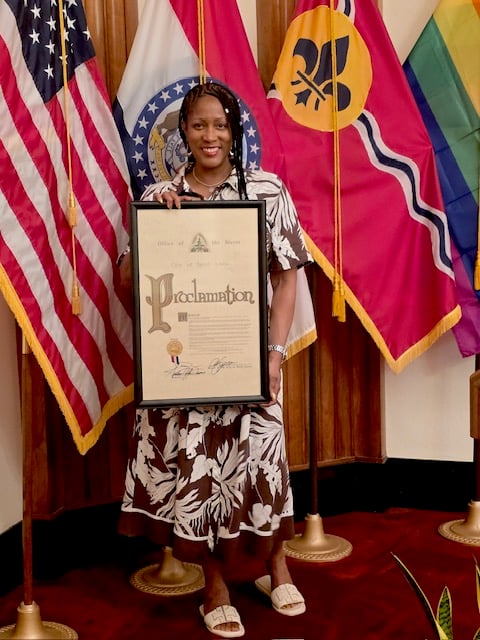
The event also marks the first official observance of Descendants of the St. Louis University Enslaved Ancestor Remembrance Day. The designation comes through a proclamation issued by St. Louis Mayor Cara Spencer and a resolution sponsored by Missouri State Representative Raychel Proudie, underscoring growing efforts by local leaders to acknowledge the region’s complex history and honor those whose labor helped shape St. Louis.
Representative Proudie is expected to deliver opening remarks during the ceremony, while descendants, community members, clergy, historians, and supporters gather to commemorate ancestors whose stories have long remained absent from traditional historical narratives.
The Descendants of the St. Louis University Enslaved organization has spent years researching family histories, reconnecting descendants, advocating for historical recognition, and educating the public about the more than 70 African American men, women, and children enslaved by the Jesuits in Missouri between 1823 and 1865. Their forced labor helped build and sustain Saint Louis University, St. Stanislaus Novitiate, St. Francis Xavier College Church, and other Catholic institutions that continue to serve the community today.
“For many families, history did not begin with a name engraved on a monument,” the organization’s work demonstrates. “It began with generations whose lives were undocumented, whose contributions were uncompensated, and whose final resting places often went unmarked.”
The dedication of the Mills-Chauvin headstone represents more than a cemetery memorial. It symbolizes a broader movement toward historical truth, remembrance, and reconciliation. Across the country, descendants of enslaved people connected to colleges, universities, churches, and other institutions have sought greater recognition of the individuals whose labor laid the foundations for many of America’s enduring institutions.
Robin Proudie, founder of DSLUE, has emerged as one of the leading voices in that movement, helping descendants reclaim family histories while encouraging institutions to confront the realities of slavery within their own past. Under her leadership, DSLUE has worked to restore forgotten family connections and ensure that the stories of enslaved ancestors become part of the broader American narrative.
As America reflects on 250 years of independence, organizers say the observance serves as an opportunity to broaden the nation’s understanding of its founding story by recognizing those whose lives and labor were essential to its development, even though their names were often left out of history books.
Community members are invited to attend the free public ceremony at Calvary Cemetery, 5239 West Florissant Avenue, on Sunday, June 28. Tent-covered seating will be available, and registration information is available through DSLUE.
For many in attendance, the ceremony will not simply commemorate the past—it will restore dignity, acknowledge sacrifice, and affirm that every chapter of American history deserves to be remembered.

