

The future USS Doris Miller was formally named in 2020. Reports now suggest officials may replace Miller’s name with President Donald Trump’s, although no final decision has been announced.
By Argus Staff
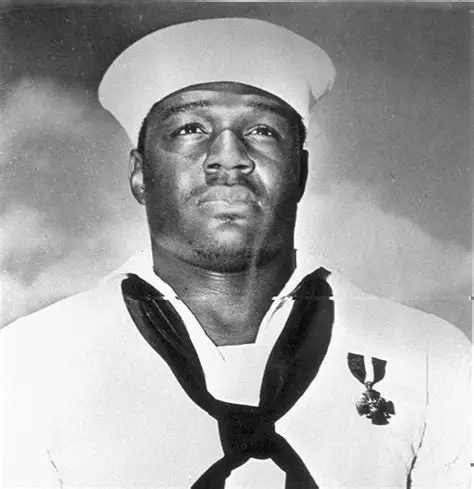
The U.S. Navy is reportedly considering removing the name of World War II hero Doris “Dorie” Miller from a future aircraft carrier and potentially naming the vessel for President Donald Trump—a move that would reverse one of the most significant recognitions ever extended to a Black enlisted sailor.
In January 2020, the Navy formally announced that the fourth Gerald R. Ford-class aircraft carrier, CVN-81, would be named the USS Doris Miller. The announcement was made during a Martin Luther King Jr. Day ceremony at Pearl Harbor. The vessel would become the first aircraft carrier named for an African American and the first honoring a sailor for actions performed while serving in the enlisted ranks.
Recent reports indicate that Navy officials have discussed replacing Miller’s name and possibly honoring Trump instead. ABC News reported that three sources familiar with the matter confirmed internal discussions during the summer. No final decision has been announced, and neither the Navy nor the White House has publicly confirmed that the carrier will be renamed.
Naming a Navy vessel for a sitting president would be unprecedented. Although several carriers have been named for former presidents, the prospect of displacing Miller’s name has raised questions about historical memory, political self-promotion and the treatment of Black military service.
The Heroism of Dorie Miller
Doris Miller was born October 12, 1919, in Waco, Texas. The son of sharecroppers, he enlisted in the Navy in 1939 and was assigned to duties available to many Black sailors in the segregated military—primarily cooking, cleaning and serving officers.
On December 7, 1941, Miller was serving aboard the battleship USS West Virginia when Japanese forces attacked Pearl Harbor. Miller was collecting laundry when the alarm sounded. He reported to his battle station, but that area had already been destroyed.
Miller then helped carry wounded sailors, including the ship’s mortally wounded commanding officer, Capt. Mervyn Bennion, to greater safety. Although he had not been formally trained to operate the weapon, Miller took control of an antiaircraft machine gun and fired at attacking Japanese aircraft until his ammunition was exhausted.
For his actions, Miller received the Navy Cross, the service’s second-highest decoration for combat heroism. He became the first Black American awarded the Navy Cross. His courage challenged the racist assumptions used to restrict Black sailors from combat roles and became a powerful symbol for the Double V campaign—victory against fascism abroad and racism at home.
Miller continued serving after Pearl Harbor. On November 24, 1943, he was aboard the escort carrier USS Liscome Bay when it was struck by a Japanese torpedo during operations near the Gilbert Islands. Miller was among the hundreds of sailors killed. He was 24 years old.
More Than a Name
The naming of CVN-81 was never simply ceremonial. Aircraft carriers are among the most visible symbols of American military power. Placing Miller’s name on one recognized not only his individual courage but generations of Black service members who defended a country that often denied them equal treatment.
The carrier is being constructed in Virginia, with its keel expected to be laid by the end of 2026 and delivery anticipated in 2034. The Trump administration has already directed design changes involving the ship’s aircraft-launch system, but changing its name would carry a different historical and moral consequence.
Presidents receive monuments, libraries, highways and public buildings bearing their names. Dorie Miller earned his place in history under enemy fire—while serving in a segregated Navy that did not initially train or permit him to perform the combat role he assumed when his country needed him.
Until an official decision is issued, reports of a USS Trump remain unconfirmed. What is confirmed is that CVN-81 was formally named for Doris Miller in 2020 and that removing his name would take away a historic honor already granted.
The question is therefore larger than what appears on the hull of a ship. It is whether America will preserve the recognition of a Black sailor whose courage helped expand the nation’s understanding of who could serve, lead and become an American hero.
Sources
U.S. Navy: Navy Names Future Aircraft Carrier Doris Miller
ABC News: Navy mulls stripping Black war hero’s name from carrier
Reuters: Carrier construction and design changes

