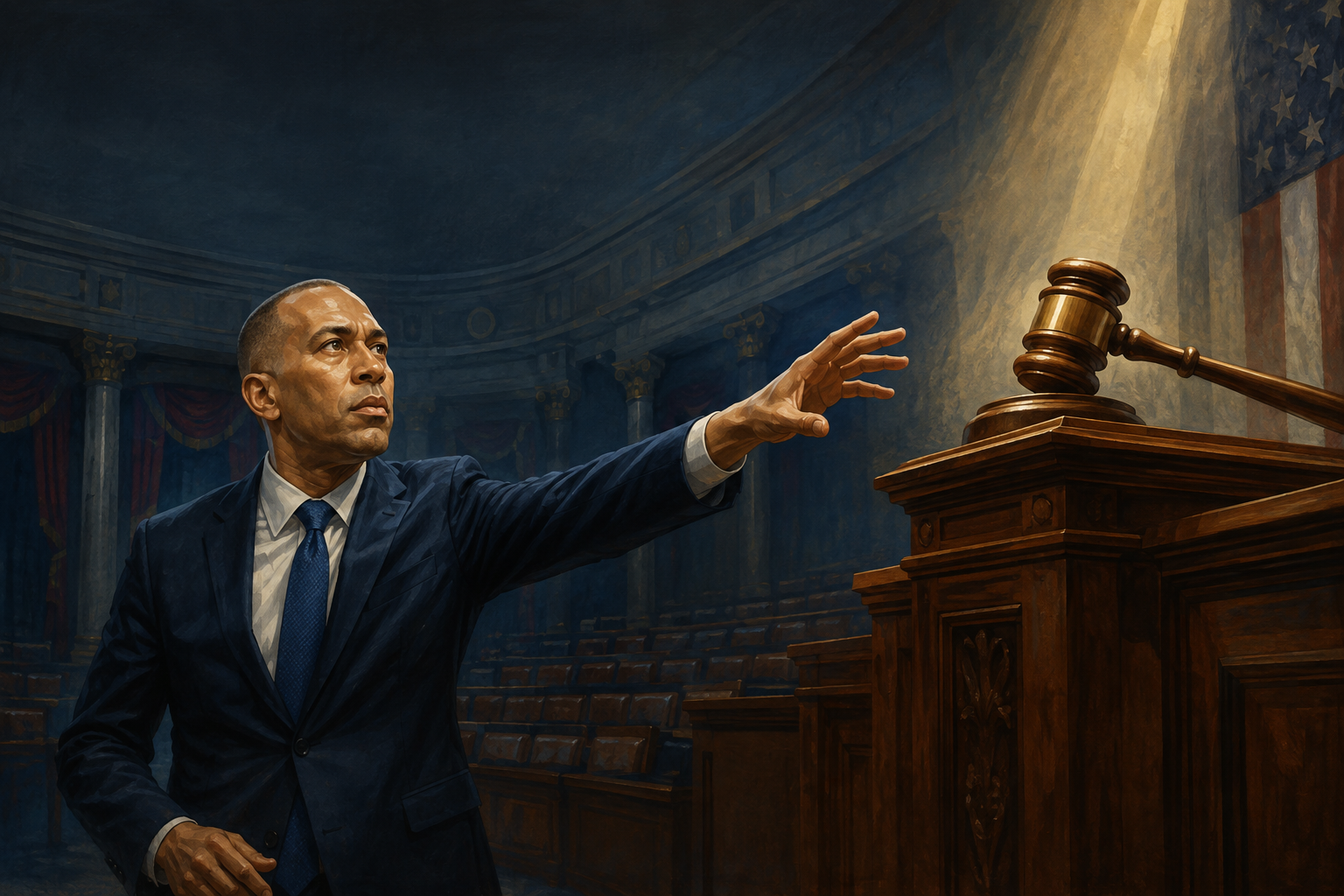

Democrats Must Debate Who Should Lead the House
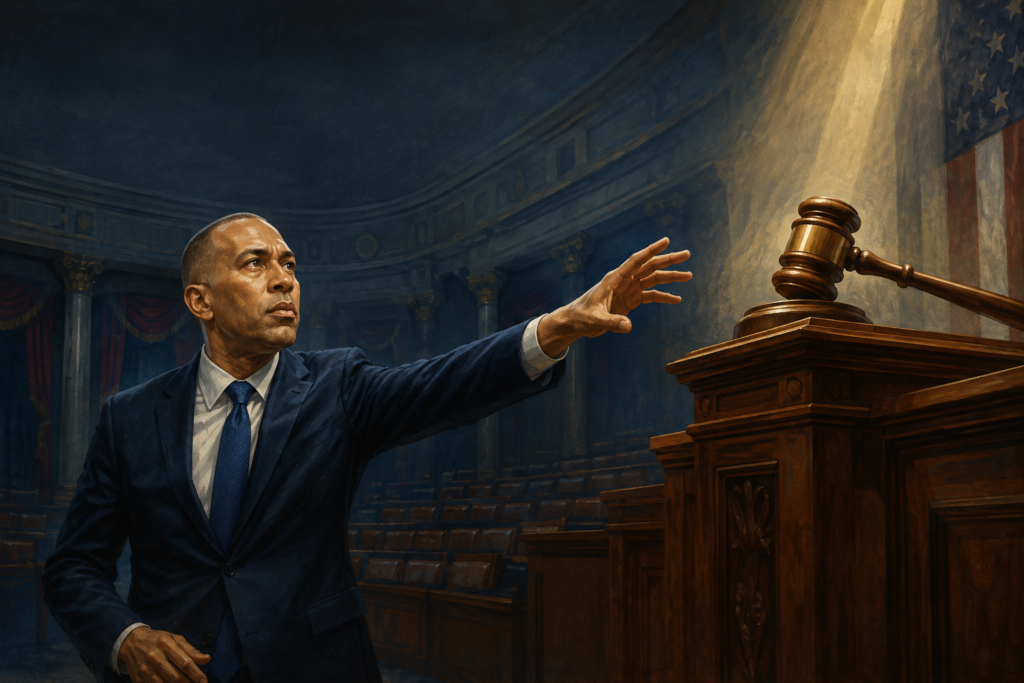
A Democratic majority should not automatically become a Jeffries speakership. The caucus owes its voters an open debate over policy, trust, moral consistency and political courage.
If Democrats win the House in the 2026 midterm elections, Hakeem Jeffries will be treated by Washington’s political establishment as the presumptive Speaker. But the speakership is not an inheritance, a reward for patiently waiting in line or a ceremonial promotion automatically granted to the minority leader.
It is one of the most powerful positions in American government. Democrats should debate who is best prepared to use that power before handing Jeffries the gavel.
The central question is not whether Jeffries can raise money, keep members in line or deliver a polished speech. It is whether he can be trusted to represent the constituencies, principles and policies responsible for rebuilding Democratic enthusiasm.
On that question, there is legitimate reason for doubt.
Jeffries recently declared that Medicare for All is not legislation he currently supports, despite having previously cosponsored single-payer legislation. He also declined to commit to bringing it to the floor if Democrats regain the majority. That is not simply a disagreement with the party’s left wing. It places him outside a policy position supported by much of the Democratic electorate.
A November 2025 Data for Progress survey found Medicare for All supported by 65 percent of voters, including 78 percent of Democrats – even after respondents were told it would replace most private insurance and require higher taxes while eliminating most premiums, deductibles and copayments.
Source: Data for Progress: Medicare for All polling
A prospective Speaker does not have to agree with every progressive proposal. But leadership requires more than describing health care as a right while refusing to support the legislation designed to make it one.
An “Ironclad” Commitment – But to Whom?
Jeffries’ relationship with the pro-Israel political establishment raises deeper concerns. Pro-Israel organizations contributed approximately $460,000 to his campaign during the period preceding his elevation to Democratic leader, with Pro-Israel America reported as his largest contributor. He has maintained close ties to AIPAC and participated in AIPAC-affiliated travel to Israel.
Source: The Guardian: Jeffries’ ties to pro-Israel groups
Money alone does not prove that a politician’s position has been purchased. But it becomes impossible to ignore when financial relationships and public policy repeatedly travel in the same direction.
Jeffries has described America’s commitment to Israel’s security as “ironclad.” In July 2026, he opposed an amendment that would have eliminated $3.3 billion in annual military assistance to Israel, even as more than half of House Democrats voted to end that aid. Democratic Whip Katherine Clark supported the amendment.
Source: Associated Press: House Democratic vote on Israel aid
This was not a fringe rebellion. It reflected a profound change within the Democratic electorate and the country.
An independent United Nations Commission of Inquiry concluded in September 2025 that Israel had committed genocide against Palestinians in Gaza. Amnesty International, B’Tselem and Physicians for Human Rights Israel reached similar conclusions. Israel rejects the accusation. But a Democratic leader cannot credibly dismiss this growing body of evidence while asking Americans to accept unlimited military support as unquestionable policy.
Source: United Nations Human Rights Office: Commission of Inquiry finding
Source: Amnesty International: Gaza genocide report
At a time of rising national debt, unaffordable health care, housing insecurity and deteriorating public institutions, “ironclad” loyalty to another government cannot replace a sober assessment of American interests, international law and Palestinian humanity.
The Randy Fine Test
If Jeffries can condemn Dan Bilzerian for comments and campaign material that were widely viewed as antisemitic, he should be able to show the same urgency and moral clarity when Muslims and Palestinians are subjected to dehumanizing rhetoric.
Bilzerian challenged Florida Republican Rep. Randy Fine in the 2026 Republican primary and produced campaign material that invoked Hitler, attacked Fine’s Jewish identity and employed antisemitic imagery.
Source: Deseret News: Reactions to Bilzerian campaign advertisement
The issue is not whether antisemitism should be condemned. It must be. The issue is whether Democratic leadership will apply the same standard when the targets are Muslims, Arabs or Palestinians.
Fine has repeatedly used dehumanizing language against Muslims and Palestinians. He referred to a fellow member of Congress as a “Muslim terrorist,” responded to images of starving Palestinians with “#StarveAway,” and later wrote that choosing between dogs and Muslims was “not a difficult” choice. During a congressional hearing, he suggested that Palestinians and what he called “mainstream Muslims” should be destroyed.
Source: Reuters: Condemnation of Fine’s anti-Muslim comments
Source: CAIR: Fine’s anti-Muslim and anti-Palestinian rhetoric
Accuracy requires acknowledging that Jeffries has condemned some of Fine’s anti-Muslim rhetoric. He joined other Democratic leaders in denouncing Fine’s attack on Rep. Ilhan Omar in July 2025 and called Fine an “unrepentant bigot” following his February 2026 comments about Muslims.
Source: Reuters: Democratic leaders condemn Fine’s remarks about Omar
The deeper criticism is that Democratic leadership too often appears louder, faster and more institutionally unified when confronting antisemitism than when Muslim, Arab or Palestinian communities are dehumanized.
Antisemitism and Islamophobia must both be condemned without calculation, qualification or delay. A leader seeking to represent a diverse Democratic coalition should never leave any constituency wondering whether its humanity ranks lower in the party’s moral order.
The Kushner Meeting and the Crisis of Trust
That distrust deepened after Jeffries met privately with Jared Kushner in New York. Kushner holds no formal government position, yet the two reportedly discussed housing, immigration and the cost of living.
Jeffries said Kushner requested the meeting and defended it as an effort to explore possible bipartisan action. He also insisted that no member of the “Trump cartel” would receive a pass if Democrats regain power.
Source: Associated Press: Jeffries-Kushner meeting
Source: Axios: Reaction to the Jeffries-Kushner meeting
Meeting with an adversary is not automatically disqualifying. Politics requires negotiation. But private discussions with an unofficial member of the Trump family – just as Democrats appear positioned to reclaim subpoena power – raise obvious questions.
Why Kushner? Who authorized him to negotiate? What commitments were discussed? Why did Democrats and the public learn about the meeting afterward?
The problem is not merely optics. It is that Jeffries has not accumulated enough trust among progressives, younger voters, Muslim and Arab Americans, anti-war Democrats and working-class constituencies to receive the benefit of every doubt.
Democrats Have Other Choices
If Democrats win the House, they should hold an open leadership debate rather than stage a coronation.
Katherine Clark is the most institutionally plausible alternative. As Democratic whip, she has leadership experience, relationships across the caucus and a record of counting votes. Her decision to support ending the $3.3 billion in military aid to Israel demonstrated a willingness to depart from Jeffries on a defining moral and foreign-policy question.
Jamie Raskin would offer constitutional knowledge, moral clarity and a proven ability to explain complex issues to the public. He has been one of the party’s most effective defenders of democracy and congressional authority. His challenge would be converting respect across the caucus into the organizational machinery necessary to manage a narrow majority.
Pramila Jayapal, a principal architect of Medicare for All and former Congressional Progressive Caucus chair, would bring policy substance and organizing experience. She may face resistance from corporate Democrats, but that resistance is precisely why her voice belongs in the discussion.
Greg Casar, chair of the Congressional Progressive Caucus, represents the party’s emerging labor-oriented, multiracial and economically populist wing. He may be considered too new for the speakership, but no leadership arrangement should be accepted without his caucus receiving meaningful influence over the agenda.
Ro Khanna offers another potential bridge. He supports Medicare for All, has questioned excessive military intervention and can speak about technology, manufacturing and economic renewal in language that reaches beyond the traditional progressive base.
The best consensus candidate may ultimately be Clark or Raskin. It could also be another member capable of combining institutional competence with economic populism, moral consistency and the courage to confront corporate power.
The Constitution does not expressly require the Speaker to be a sitting House member, although every Speaker in American history has been one. The field is legally broader than Washington custom suggests.
Source: National Constitution Center: The Speaker’s constitutional role
Make the Gavel Conditional
If Jeffries wants to become Speaker, Democrats should require commitments before giving him their votes:
Bring Medicare for All to the floor.
Protect congressional investigations from private political bargains.
Refuse campaign money that compromises – or appears to compromise – the party’s independence.
Apply the same moral standard to antisemitism, Islamophobia, anti-Black racism and anti-Palestinian dehumanization.
Restore Congress’ constitutional authority over war and military spending.
Guarantee progressives, labor advocates and the communities generating new Democratic enthusiasm a meaningful role in setting the agenda.
The Democratic Party has recently been energized by candidates running on affordability, universal health care, labor rights, housing, restraint abroad and resistance to corporate control. That energy will not survive if voters conclude that their participation is welcomed during elections but discarded when leadership positions are distributed.
Democrats may have an opportunity to regain the House, and perhaps eventually the Senate and presidency. But regaining power without changing how that power is exercised will only postpone another collapse.
Hakeem Jeffries may still win the speakership. He should not receive it by default.
The Democratic caucus owes its voters a debate, a choice and a leader whose courage extends beyond the boundaries established by donors, consultants and the corporate wing of the party.
The gavel belongs to the people’s House. Democrats should make every candidate prove they are worthy of holding it.